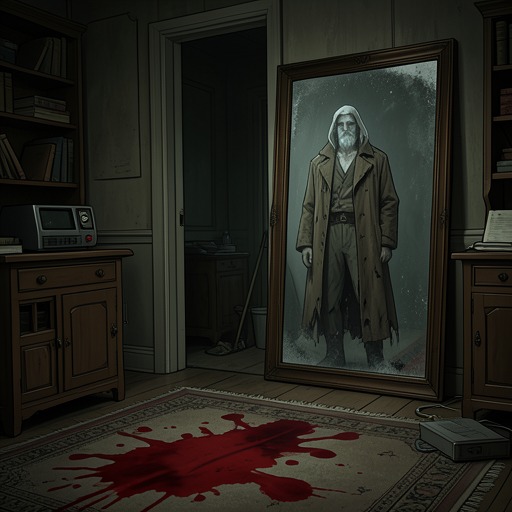
Canterville bloodstain
The Canterville GhostThe Canterville bloodstain is the library-floor mark associated with the murder of Lady Eleanore de Canterville by her husband, Sir Simon de Canterville. First treated by the Otis family as a stain to be cleaned, it repeatedly returns despite their efforts and becomes a visible trace of the violence and unresolved history behind the haunting of Canterville Chase.
Origin and Introduction
When the Otis family arrives at Canterville Chase, Mrs. Otis notices a dull red mark beside the fireplace in the library. Unaware of its supposed significance, she assumes something has been spilled and asks the housekeeper, Mrs. Umney, to have it removed. Mrs. Umney answers that blood was spilled on that spot, immediately turning an ordinary housekeeping problem into the household’s first encounter with the estate’s violent past.
Mrs. Umney identifies the mark as the blood of Lady Eleanore de Canterville, who, she says, was murdered there by her husband, Sir Simon de Canterville, in 1575. Sir Simon lived nine years after the murder, then disappeared under mysterious circumstances; his body was never found, and his guilty spirit was said to haunt the Chase. The stain had attracted admiration from tourists and others, but Mrs. Umney insists that it cannot be removed. Its location in the library makes the household’s most domestic setting a point of contact with an old family crime.
Cleaning and Recurrence
Washington Otis rejects Mrs. Umney’s explanation and applies Pinkerton’s Champion Stain Remover and Paragon Detergent to the floor. He scrubs the mark away with a small stick of cleaning product, and, for a moment, no trace remains. The family’s practical confidence appears vindicated; almost immediately, however, lightning and thunder interrupt their celebration, and Mrs. Umney faints.
The mark is back on the library floor the next morning. Washington tries the detergent again, and it returns on the following morning as well. Its recurrence becomes harder to dismiss when the library is locked overnight by Hiram B. Otis himself, who carries the key upstairs. The stain thus resists both a commercial cleaner and the family’s attempt to secure the room, making its persistence a repeated challenge to their explanations of the house.
For the rest of that week, the family continues to find the mark despite the library door being locked and the windows kept barred. Its colors vary: it appears dull red, vermilion, rich purple, and, one morning, bright emerald-green. The family treats the transformations as an amusing puzzle and even places bets on the color, but Virginia Otis is distressed by the sight. The contrast between the family’s amusement and Virginia’s unease gives the recurring object different meanings within the same household: spectacle for some, a troubling reminder for her.
The Stain as a Disputed Sign
The stain’s shifting colors unsettle the apparent relationship between mark and meaning. Mrs. Umney presents it as a material witness to Lady Eleanore’s murder, while the family initially sees a domestic blemish that ought to yield to cleaning. Its green appearance especially makes the inherited story seem incongruous to the Otises. Yet the very absurdity of the changing colors does not make the mark disappear; recurrence, rather than any single hue, keeps its connection to the house’s past in view.
The mark also becomes entangled with the haunting’s comic struggle over who can control its appearance. Sir Simon takes colors from Virginia’s paintbox to renew it: first her reds, including vermilion, then emerald-green and chrome-yellow. This leaves her with indigo and Chinese white, restricting her to moonlight scenes, which she finds depressing and difficult to paint. When she confronts him, Sir Simon explains that genuine blood is difficult to obtain and argues that Washington’s cleaning began the exchange. The bloodstain is therefore not simply a fixed relic: its visible form is repeatedly produced, erased, and restored through actions that bring the old ghost into conflict with the family’s present-day routines.
Historical Disclosure and Significance
The explanation of the stain anticipates a deeper discovery. After Virginia has been with Sir Simon, she tells her family that he is dead and that he gave her a box of jewels before his death. She leads them through an opening in the wainscoting and down a secret corridor to a small, low room. There, chained to an iron ring in the wall, they find Sir Simon’s skeleton beside a trencher and ewer placed beyond its reach. Virginia kneels beside the skeleton and prays as the family witnesses the tragedy whose secret has been disclosed.
The revelation supplies a material history to the haunting and changes the family’s understanding of the stain’s origin: the story concerns not only Lady Eleanore’s murder but also Sir Simon’s own fate. The bloodstain’s repeated return has kept that concealed past present in the library, even as the Otises treat it as a practical nuisance or a source of amusement. Its comic transformations do not erase its association with violence; instead, the contrast between the changing surface and the buried secret makes it one of the narrative’s persistent links between domestic life, family history, and the ghost’s eventual release.